
Technology Department
The Technology department is offering an extremely wide variety of courses. These courses are a significant part of the general education that provides students with the opportunity to learn about the theoretical and practical aspects of our technology. Some of the courses are designed to prepare students to successfully complete the requirements needed for certification.
The classes provide a combination of laboratory and lecture environment. The students have the opportunity to study materials, processes, and production methods. They are involved in planning, organizing, creating, constructing, experimenting, testing, servicing, and evaluating. Technology education inspires thinking, encompasses the arts and sciences, and promotes problem solving.
Those students interested in preparing for a career in the vast field of technology will find these classes ideally suited to their needs. Students will develop a thorough foundation of study in this area. These classes are design-oriented and students are encouraged to probe deeper into the area they find to be of special interest. Students are exposed to visitors from industry, colleges, and universities to discuss career awareness. Furthermore, technology education goes beyond the classroom to visit industry for a first-hand look. Through the years we have established relationships and partnerships with industry leaders and institutes of higher education.
We are committed to providing a strong academic program, career-informed courses, and work-based experiences to ensure that our graduating students have marketable skills, as well as the qualifications needed to attend college.
What value does Technology Education have for your child?
1. Marketable Skills
Provide knowledge needed for the college and non-college bound student so he or she will have marketable skills and knowledge built on a strong theoretical background. These skills will meet the entry-level job requirements in technical areas. Career guidance and trips to industry, help students to make the most important decision in life…What will they do when they enter the world of work?
2. Participate in Education Expenses
Technology Education can help students to better get jobs with better salaries. Students can work part-time while fulfilling their educational goals.
3. Broaden Your Knowledge
The knowledge obtained in Technology Education will be valued more as the years go by. Technology Education will be a guide to make the right decision with every item you purchased, with every item you maintained or with every mechanical or electrical problem that occurs.
4. Develop Achievement Skills
Technology Education instills the desire to learn because every student feels a sense of accomplishment. A student in this field usually develops: Self-confidence, self-awareness, good working habits, good problem-solving skills and reliability.
Areas where certification can be obtained:
- Technology Computer Applications, IC3
- Microsoft Office, MOS
Course Listings
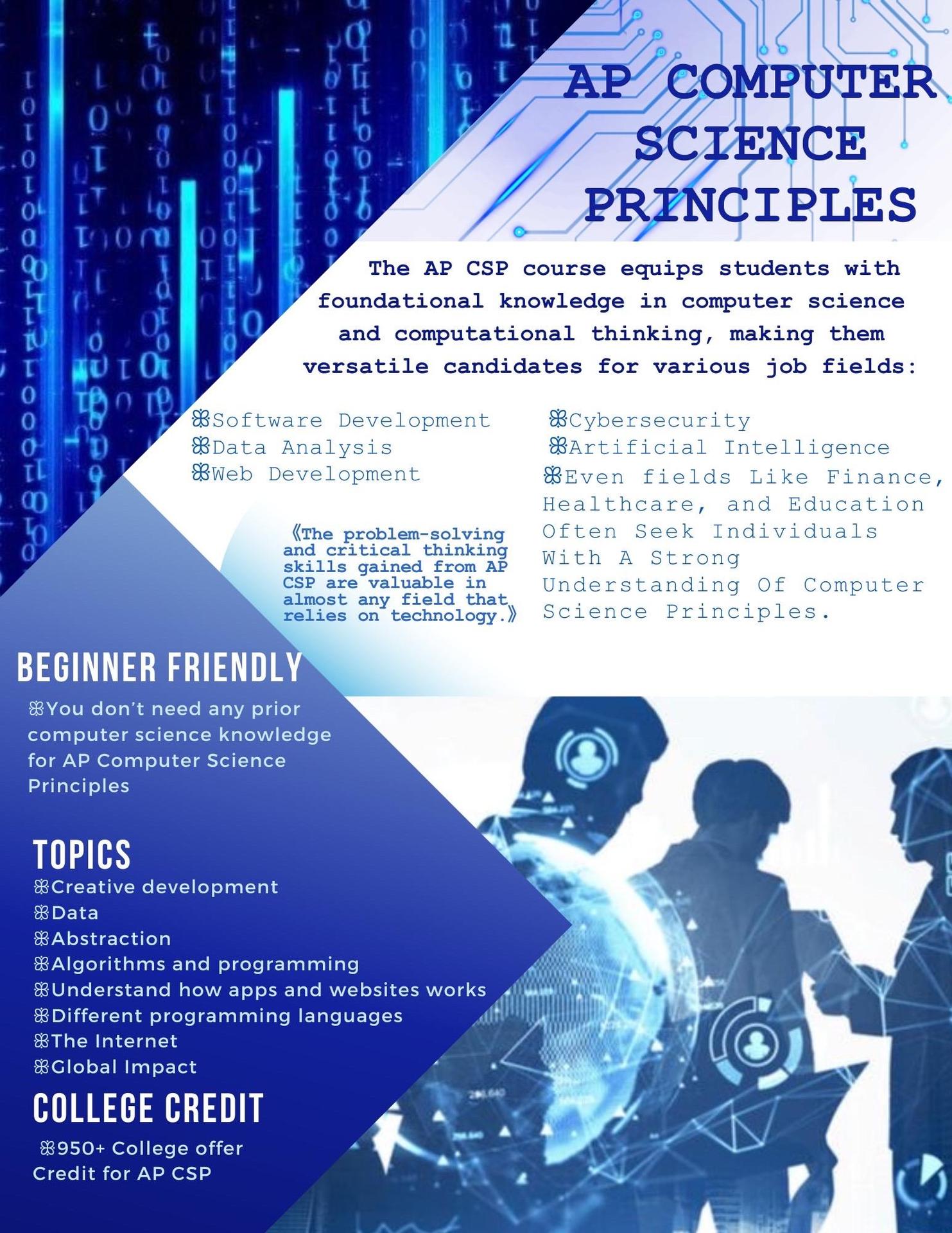
AP Computer Science Principles
Course Code: TQS21XP & TQS22XP
AP Computer Science Principles (AP CSP) is a full-year, rigorous course that introduces students to the foundational concepts of computer science and explores the impact computing and technology have on our society. The course covers a broad range of foundational topics including: programming, algorithms, the Internet, big data, digital privacy and security, and the societal impacts of computing.
AP Computer Science A
Course Code: TQS21X & TQS22X 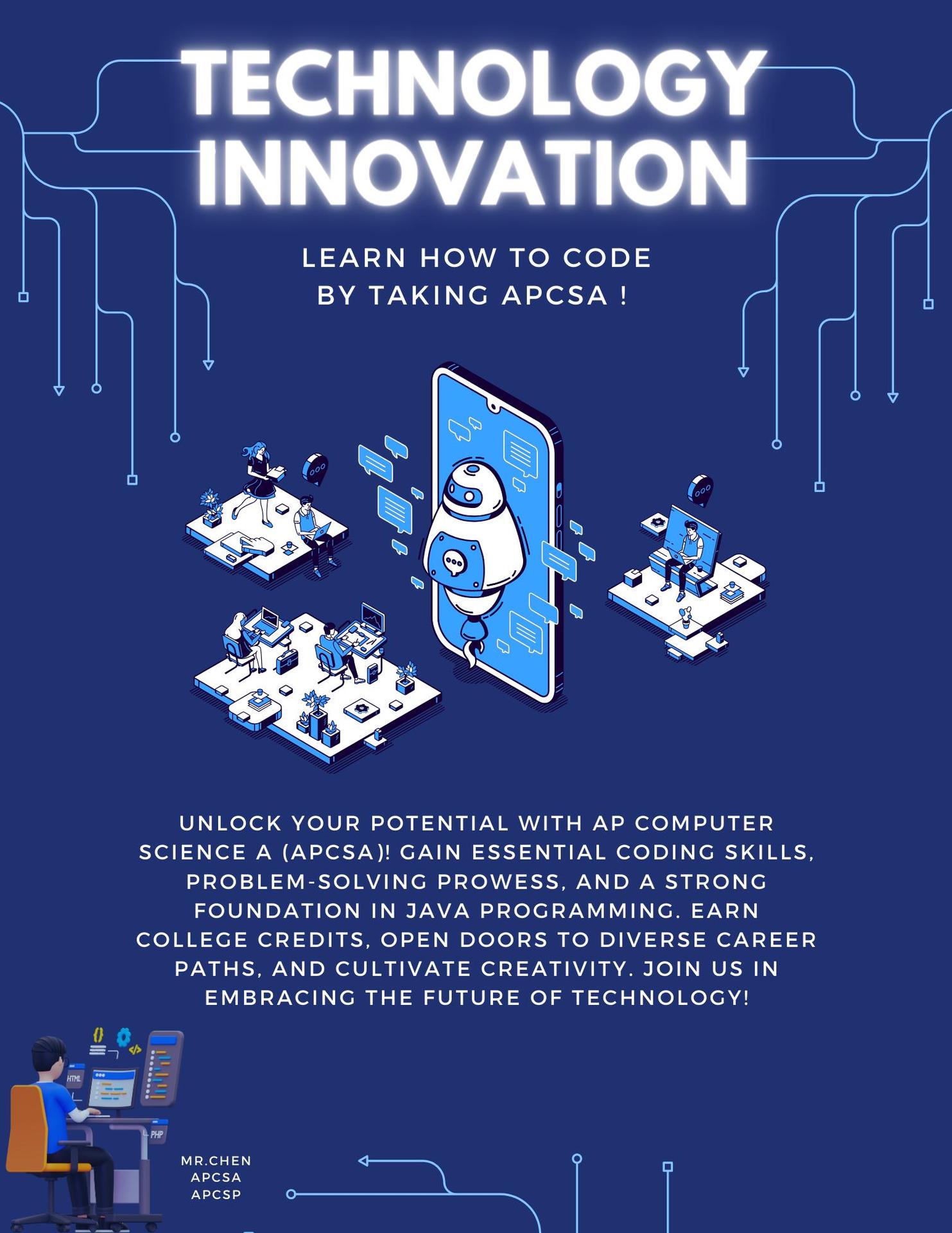
AP Computer Science A is both a course for potential computer science majors and a foundation course for students planning to study in other technical fields such as engineering, physics, chemistry, and geology. The course emphasizes programming methodology, procedural abstraction, and in-depth study of algorithms, data structures, and data abstractions, as well as a structured lab component comprised of a minimum of 20 hours of hands-on lab experiences integrated throughout the course. Instruction includes preparation for the AP Computer Science A Exam. Students should leave this course with a clear understanding of Java and the ability to adapt to any new programming language that they are taught in college.
Course Code: MKS11
This one semester course is an introduction to programming using the C++ programming language. Students learn how to write programs in an object-oriented high-level programming language. Topics covered include fundamentals of algorithms, flowcharts, problem solving, programming concepts, arrays and strings. Throughout the semester, problem solving skills will be stressed and applied to solving computing problems. By the end of the semester, students are expected to have a good understanding about the concept of object-oriented programming using C++ and be able to write and read basic C++ code.
Computer Applications
Course Code: TWS11
The IC3 program is a comprehensive program designed to teach students Internet and Computer technology skills. This comprehensive global learning program offers students an opportunity to pursue IT curricula through instructor-led training and hands-on laboratory exercises. The Computing Fundamentals unit provides information on computing basics, including computer hardware and components, applications and operating system software, and social issues related to computing and technology. The Key Applications unit focuses on software applications that learners use on a regular basis. The Living Online unit covers the concepts of computer networking, with comprehensive coverage of the Internet and the various services and resources it offers.
Cyber-Security
Course Code: TYS11
This course provides the foundation for understanding the key issues associated with protecting information assets, determining the levels of protection and response to security incidents, and designing a consistent, reasonable information security system, with appropriate intrusion detection and reporting features. The purpose of the course is to provide the student with an overview of the field of information security and assurance. Students will be exposed to the spectrum of security activities, methods, methodologies, and procedures. Coverage will include inspection and protection of information assets, detection of and reaction to threats to information assets, and examination of pre- and post-incident procedures, technical and managerial responses, and an overview of the information security planning and staffing functions.
3D Design & Production
Course Code: ADS11Q3D Course Web Page
This is a fun, hands-on course where students learn how to design and create 3D models and turn them into real objects using 3D printers. Students will use easy-to-learn 3D design software and explore more advanced tools to build their own creations. The class covers how to create printable 3D files and how 3D printers work. This includes preparing files, choosing settings, and working with different materials. Students will also discover how 3D modeling is used in industries like video games, movies, and product design. By the end of the course, students will have designed and printed their own projects, gaining both creative and technical skills.
Anime Class
Course Code: AES11 : Course Website
The course is an interdisciplinary class with its focus on Anime/Manga art and writing stories. In the beginning of the course students learn about the history of Anime and Manga and analyze anime clips. During the rest of the course students learn how to create Anime style art and at the same time learn about proper artistic techniques. Next, students learn how to write short stories (fundamentals of writing manga) and use them to create a manga, as their final project. They will learn about visual story telling by creating sequential art and learn about comic book art techniques. Additionally, students will have the opportunity to learn how to use different technologies to create 2D and 3D artwork. Students have the option of taking the second semester of the course, where they will learn how to create animations with Adobe Photoshop's timeline and create soundtracks with GarageBand.
Jewelry
Course Code: AYS11
The first semester of this course is geared toward developing and improving the student's technological skills in designing, handcrafting, problem solving, conceptual skills, and an understanding of the use of tools, materials and processes. Using the technique and art of Wire-Wrapping, elegant pieces of jewelry are created. The second semester of this course is designed to use the process of Lost-Wax Casting to produce artistic, elegant, original and one-of-a-kind pieces of jewelry. These artistic designs are cast into metals such as gold and silver.
Microsoft Office Certification
Course Code: TUS11
The Microsoft Office Specialist Program enables candidates to learn and show that they have something exceptional to offer – proven expertise in specific Microsoft programs. The Microsoft Office Specialist Program is the only Microsoft-approved certification program of its kind. During the course of study, students will learn and test in the following software: Word, Excel, PowerPoint and Access. The course is project led and involves presentations, class discussions, note taking, homework, formal testing and other assessments, and lab assignments.
Python Programming
Course Code: TQS21QP & TQS22QP
This course is designed to offer an introduction to computer science. Students will learn the basics of computer programming along with the basics of computer science. The material emphasizes computational thinking and helps develop the ability to solve complex problems. This course covers the basic building blocks of programming along with other central elements of computer science. It gives a foundation in the tools used in computer science and prepares students for further study in computer science, including AP Computer Science Principles and AP Computer Science A courses.
Robotics
Course Code: MQS11QBR
This is a beginning course in robotics. We will be utilizing Lego Mindstorm kits, Tetrix Kits, Robotc software and various Lego Robotics materials. The objective of this course is to introduce the students to basic programming as well as problem solving strategies. This course will involve students in the development, building and programming of a Tetrix Robot, incorporating the Lego Mindstorm kits. Students will work hands-on in teams to design, build, program and document their progress. Topics may include motor control, gear ratios, torque, friction, sensors, timing, program loops, logic gates, decision-making, timing sequences and binary number systems. Student designed robots will be programmed to compete in various courses against their peers.
Web Design
Course Code: TQS11QWD
This course is designed to introduce students to the basic elements of web design and development. Students will learn about content placement, use of color and graphics, typography and message using industry-standard software. Students are introduced to various web design languages, design concepts, and layout theory. Students will become familiar with marketing and other uses of websites; as well as ethical and legal issues related to websites. The second semester is a continuation of Web Design and Development I. This extension is designed for intermediate students to create websites for a variety of purposes. Students will develop their knowledge of content, placement, use of color and graphics, typography and message. Students will use various web design languages, design concepts, and layout theories to create their websites. Students will examine the role of marketing, market research, ethics and legal issues as it relates to websites. Project-based learning, collaboration, and portfolio development are essential elements of this class. The appropriate use of technology and industry-standard equipment is an integral part of this course. (Full year course)
Game Theory
Course Code: TQS11QGT
The game design class uses the c# language and the unity platform to make 2D games. Throughout the course, students make various games from scratch including a 2D plat-former, trivia quiz game and more. For the final project students will work in groups to create their own project. The course will cover some basic physics (collision detection, force and acceleration), vector addition and subtraction, geometry manipulation, simple animation states, and sprites (game images). Students will be able to make their own game and export it as an executable file to run on their own computers and mobile phone.